Mailtrap vs Mailgun vs Amazon SES: Which Email Sending API Is Best in 2026?
- 4 days ago
- By Mounika
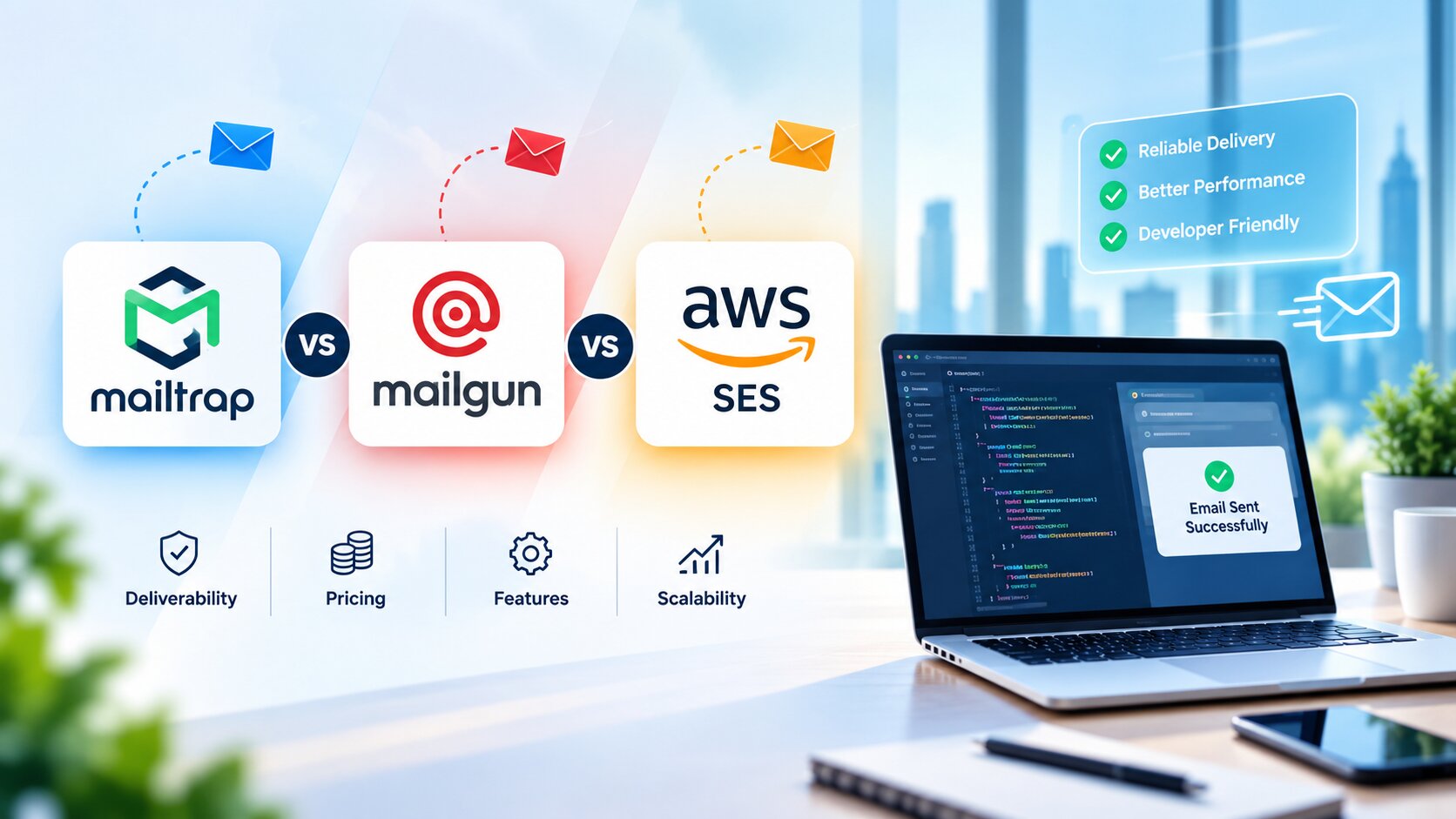
Mailtrap, Mailgun, and Amazon SES are three of the most widely used email sending APIs for developers in 2026, and each takes a different approach to the same job: getting transactional messages into the inbox reliably. One ships deliverability infrastructure by default, one builds its reputation on flexible inbound routing and address validation, and one hands you raw AWS building blocks at the lowest per-email cost on the market. We compared all three on deliverability infrastructure, developer experience, and pricing, using each provider's current docs and pricing pages.
Mailtrap vs Mailgun vs Amazon SES: Quick Comparison
| Mailtrap | Mailgun | Amazon SES | |
| Best For | High deliverability and analytics | Flexible routing and validation | Cost efficiency on AWS |
| Stream Separation | Native | Subdomain-based | Manual (IP pools) |
| Uptime SLA | 99.99% | 99.99% | 99.9% |
| Free Tier | 4,000 emails/mo | 100 emails/day | 3,000 emails/mo* |
| Starting Paid Plan | $15/mo for 10K emails | $15/mo for 10K emails | $0.10 per 1,000 emails |
| Dedicated IP | Included on Business and Enterprise | $59/mo add-on | $24.95/mo add-on |
| G2 Rating | 4.8/5 | 4.2/5 | 4.3/5 |
*Amazon SES's 3,000-email free tier applies only to AWS accounts created before July 2025. Newer accounts get AWS credit instead and pay standard rates from the first send.
An email sending API is the programmatic interface, REST or SMTP, that a backend uses to trigger transactional messages such as password resets, receipts, and 2FA codes. Mailtrap includes native stream separation, automatic DKIM rotation, and analytics without extra setup. Mailgun adds regex-based inbound routing and built-in address validation as part of its core feature set. Amazon SES prices per email rather than by plan, which lowers the cost per message for teams able to build the surrounding infrastructure themselves.
How to Choose
Choose Mailtrap if you want high deliverability, detailed analytics, and native stream separation without assembling that infrastructure yourself.
Choose Mailgun if conditional inbound routing based on regex patterns, or built-in address validation before sending, are core requirements for your workflow.
Choose Amazon SES if your stack already runs on AWS, per-email cost is the binding constraint, and your team has the DevOps capacity to build bounce handling and monitoring on Lambda and SNS.
Mailtrap: Email Sending API for Developers and Product Teams
G2: 4.8/5
Mailtrap is an email sending API built for developers and product teams that need high inbox placement and detailed analytics. Transactional and bulk traffic run on isolated sending streams by default, on every plan including the free tier.
Authentication and Deliverability
SPF, DKIM, and DMARC configure automatically once the DNS records are in place. DKIM keys rotate every month without manual input. Bounce suppression runs automatically, with hard bounces, soft bounces, and spam complaints tracked and categorized separately. Mailtrap holds ISO 27001, SOC 2 Type II, and GDPR certifications, backed by a 99.99% uptime SLA.
Dedicated IPs on the Business plan include automatic warmup, which removes the two-to-four-week manual ramp schedule other providers leave to you.
SDKs and Integrations
Official SDKs cover Node.js, PHP, Ruby, Python, Java, .NET, Go, and Elixir. An official MCP server gives AI coding tools like Claude Code and Cursor direct access to sending, logs, stats, templates, and domain management. Webhooks retry up to 40 times over roughly 3.3 hours after a failed delivery attempt.
Setup takes about five minutes from account creation to first send. Drill-down analytics break delivery, opens, clicks, and bounces down by mailbox provider and sending stream.
Pricing
- Free: 4,000 emails/month
- Basic: $15/month for 10,000 emails
- Business: $85/month for 100,000 emails
- Enterprise: $750/month for 1,500,000 emails
- Dedicated IP: included on Business and above
Mailgun: Email Sending API for Developers Building Inbound Email Workflows
G2: 4.2/5
Mailgun is an email sending API built for developers who need flexible inbound routing alongside standard transactional sending. Transactional and bulk traffic are typically separated using dedicated subdomains, a setup step handled manually rather than by default.
Authentication and Deliverability
SPF, DKIM, and DMARC require manual DNS configuration during setup. DKIM keys are not rotated automatically, so key rotation is left to the account owner. Bounce suppression runs automatically once a recipient bounces, based on Mailgun's built-in suppression list. Mailgun holds SOC 2 Type II, ISO 27001, GDPR, and HIPAA certifications, backed by a 99.99% uptime SLA.
Log retention holds at a single day on Free and Basic, then rises to 5 days on Foundation and 30 days on Scale, so a weekend incident on the entry tiers can already be gone by Monday. Address validation is bundled into the Scale plan at 5,000 checks a month; Basic and Foundation accounts can add it as a separate paid service.
SDKs and Integrations
Official SDKs cover Go, Node.js, PHP, Java, Ruby, and Python. The full API is also published as a Postman collection for teams that prefer testing requests outside their codebase. Webhooks retry for 8 hours after a failed delivery attempt.
Pricing
- Free: 100 emails/day
- Basic: $15/month for 10,000 emails
- Foundation: $35/month for 50,000 emails
- Scale: $90/month for 100,000 emails
- Dedicated IP: $59/month
Amazon SES: Email Sending API for AWS-Native Engineering Teams
G2: 4.3/5
Amazon SES is an email sending API built directly on AWS infrastructure, aimed at teams that want the lowest per-email cost available. Transactional and bulk traffic separation is left entirely to manual IP pool configuration, built using tools like Lambda and SNS.
Authentication and Deliverability
SPF, Easy DKIM, and DMARC are supported but require manual configuration. DKIM keys are not rotated automatically, leaving rotation as a manual task for the account owner. There is no native bounce suppression; bounce and complaint events fire as SNS notifications that route through Lambda or SQS. Amazon SES carries SOC 2, ISO 27001, and HIPAA-eligible compliance status, along with FedRAMP authorization and a 99.9% uptime SLA under AWS's published service commitment.
New accounts start in a sandbox mode that caps sending at 200 emails per 24 hours to addresses you've verified yourself, until AWS approves a production access request, typically a one-to-three-business-day wait. Per-provider analytics require the Virtual Deliverability Manager, a separate paid add-on.
SDKs and Integrations
AWS SDK coverage spans JavaScript, Python (boto3), Java, Go, Ruby, PHP, .NET, Rust, C++, and Kotlin, and plain SMTP works with any standard mail library. Native hooks into Lambda, S3, SNS, and EventBridge connect sending events directly into the rest of an AWS stack. Amazon SES does not use traditional webhooks; delivery, bounce, and complaint events fire through SNS instead, with retry behavior handled by the subscriber's own SNS or SQS setup.
Pricing
- Free tier: 3,000 emails/month for 12 months (accounts created before July 2025 only)
- Pay-as-you-go: $0.10 per 1,000 emails
- Dedicated IP: $24.95/month (standard) or $15/month plus usage (managed)
Deliverability and Authentication Compared
Stream separation is where the three providers diverge most. Mailtrap isolates transactional and bulk traffic at the infrastructure level by default. Mailgun gets close to the same result through subdomain recommendations that still require manual setup. Amazon SES leaves it entirely to IP pool configuration you build yourself.
DKIM rotation follows a similar pattern. Mailtrap rotates keys automatically every month. Mailgun and Amazon SES both leave rotation as a manual task, and aging keys are a well-documented, slow-to-surface cause of inbox placement drift.
| Feature | Mailtrap | Mailgun | Amazon SES |
| Stream Separation | Native | Subdomain-based | Manual (IP pools) |
| DKIM Rotation | Automatic (monthly) | Manual | Manual |
| Bounce Suppression | Automatic | Automatic | Manual (via SNS) |
| Email Validation | Not included | Scale plan only | Add-on (VDM) |
| Analytics Included | Yes | Yes (paid plans) | Add-on only (VDM) |
Pricing at Scale Compared
Amazon SES has the lowest raw per-email cost of the three at every volume tested here. The real comparison depends on whether you count the engineering time it takes to build what SES doesn't include out of the box.
| Volume | Mailtrap | Mailgun | Amazon SES |
| 10,000 emails/mo | $15 | $15 | ~$1 |
| 100,000 emails/mo | $85 | $90 | ~$10 + add-ons |
| Dedicated IP | Included (Business+) | $59/mo | $24.95/mo |
Mailtrap is the only one of the three that bundles a dedicated IP into a plan instead of charging for it separately. Mailgun and Amazon SES both treat dedicated IPs as an add-on, and Mailgun's costs more than either alternative.
Final Verdict
For most teams comparing email sending APIs in 2026, the decision comes down to how much deliverability infrastructure you're willing to build yourself.
Mailtrap includes stream separation, automatic authentication, and analytics as part of the base setup. Mailgun fits teams that need conditional inbound routing and built-in validation as a working part of their sending pipeline, not just an occasional check. Amazon SES fits AWS-native teams with the DevOps capacity to build bounce handling and monitoring on Lambda and SNS, where per-email cost is the primary constraint.
FAQ
Q: Which Email Sending API Has the Best Deliverability in 2026?
A: Mailtrap has the most automated deliverability setup of the three: native stream separation and monthly DKIM rotation run by default. Mailgun and Amazon SES both leave more of that work to manual setup, Mailgun through subdomain recommendations and SES through IP pool configuration you build yourself.
Q: Is Amazon SES Actually the Cheapest Option?
A: Per email, yes. At $0.10 per 1,000 emails, SES undercuts both alternatives by a wide margin. The gap narrows once you factor in the engineering hours needed to build the bounce suppression, suppression lists, and delivery monitoring that Mailtrap and Mailgun both include by default.
Q: Which of These Three Has the Best Free Tier?
A: Mailtrap's free tier covers 4,000 emails per month with no expiry and no credit card required. Amazon SES's 3,000-email allowance only applies to AWS accounts created before July 2025; newer accounts get AWS credit instead and pay standard per-email rates from the first send. Mailgun's free tier caps out at 100 emails per day.
Q: What Happens to Replies Once a Transactional Email Goes Out?
A: None of the three fully answer this on their own. Mailgun can route incoming mail to a webhook based on regex rules, and Mailtrap holds inbound replies in a hosted inbox tied to the same account, but turning that into something a team can actually triage together is a separate problem. That's the gap tools like Mailtrim are built for: once a reply lands, someone still has to see it, assign it, and answer it as a group, rather than leave it sitting in a webhook payload nobody's watching.
Whichever email sending API you choose, most of the real work happens before the first send goes out, in the DNS records, the stream design, and how much of the surrounding infrastructure you decide to own instead of build yourself.